



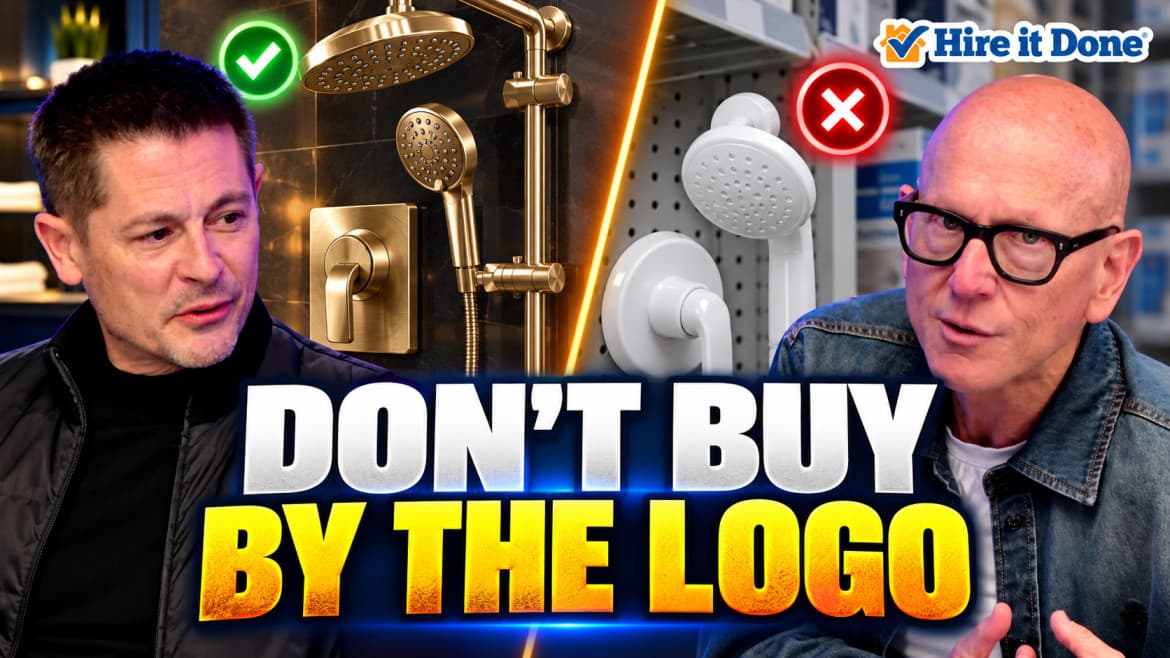

If you are remodeling a bathroom, it is easy to assume that a familiar brand name means you are comparing the same product everywhere you shop. A faucet is a faucet. A toilet is a toilet. If the logo matches, why pay attention to anything else?
That question came up in a recent Hire It Done episode with Nathan Caspers of Infusion Kitchen & Bath Showrooms. Nathan manages seven showrooms in Michigan and works with homeowners, designers, and trade professionals selecting plumbing fixtures. His advice was not to avoid big-box stores. It was to look deeper than the label before deciding what represents the best value for your project.
Same Brand May Not Mean Identical
During the episode, Adam asked Nathan directly whether a product from a big-box store is necessarily the same as a product carrying the same brand in a showroom. Nathan said there can be differences in components.
He gave examples from the products his showrooms carry, including neoprene gaskets instead of rubberized gaskets and metal or brass components instead of plastic-coated polymer in certain spray heads. Those details are not obvious when you are standing in an aisle looking at a finish and a price tag.
The practical lesson is simple: do not assume. Ask for the model number, specifications, materials, warranty, and replacement-part information for the exact product you are considering.
Ask What Is Inside
Homeowners naturally compare the features they can see. Finish, handle style, color, shape, and price are easy to understand. Internal construction is harder.
For a fixture that may be installed for years, ask what parts carry the wear. Are critical components metal or polymer? Can cartridges, valves, gaskets, or spray heads be serviced? Are replacement parts readily available?
You do not need to become a plumbing engineer. You just need enough information to understand why two products with similar styling may have different prices.
Think About Replacement Difficulty
The best value also depends on where the product is installed. A faucet mounted on an open vanity can usually be replaced with less disruption than a shower valve located behind finished tile.
The harder something is to reach, the more you should care about serviceability, parts support, warranty, and long-term reliability. Paying a little more for a component that is expensive to access later can make sense.
On the other hand, a lower-cost fixture can still be a reasonable choice for a room you are refreshing on a tight budget or a product that is easy to replace. Context matters.
Use A Working Showroom
One advantage Nathan highlighted is the ability to experience working products. At Infusion, he said customers can try shower heads, see steam systems operate, and compare how fixtures feel in use.
That matters because a spec sheet cannot tell you everything about water pressure, spray pattern, control feel, handle ergonomics, or how a finish looks under real lighting.
If you have access to a working showroom, use it. Bring your plans, photos, and measurements. Ask the consultant to show you options at different price levels and explain what changes as the price goes up.
Match Quality To The Project
Nathan also said his team tries to match the value of the product to the value of the home. That is a better approach than assuming the most expensive fixture is automatically the smartest one.
Think about the room, the expected lifespan of the remodel, how often the fixture will be used, and what failure would cost you. A guest-bath faucet and a heavily used primary shower may deserve different budgets.
Your goal is not to win a luxury-product contest. Your goal is to spend where quality, service, and daily use justify it.
Big Box Can Still Be Fine
Nathan was clear that big-box products can still be good remodeler products. That is important because the choice is not showroom good, retail bad.
For many homeowners, availability, budget, and convenience matter. A retail fixture may be exactly right for the project. The mistake is treating price as the only comparison and assuming all versions are identical without checking.
Compare the exact model, construction, warranty, support, and replacement parts. Then decide which option fits your budget and your expectations.
 Compare Before You Buy
Before you purchase a faucet, toilet, shower system, or other plumbing fixture, make a short comparison list. Write down the exact model number, price, materials, warranty, included components, lead time, return policy, and where you will get replacement parts.
If the fixture is complicated or buried behind finished work, ask your plumber what they prefer to install and service. If you are buying a shower system, test the controls and spray if possible.
Also ask who you will call after the sale. A low price feels less attractive if a small replacement part becomes difficult to source or if nobody can explain the warranty process. Keep the product paperwork, model number, finish code, and purchase record in one place. That small habit can save time years later when you need a cartridge, gasket, spray head, or other service part.
A good purchase is not always the cheapest or the most expensive. It is the one you understand before it becomes part of your house.
Frequently Asked Questions
Are showroom plumbing fixtures better than big-box fixtures?
Not automatically. Nathan explained that some showroom products can use different components or materials, but the right choice depends on the exact model, your budget, and how long you expect the fixture to stay in service.
Can the same plumbing brand have different product versions?
Yes, it can. Compare exact model numbers and specifications instead of assuming two products are identical because the brand and appearance are similar.
What should I compare besides price?
Compare materials, warranty, service support, replacement parts, included components, return policy, and how difficult the fixture will be to replace after installation.
Why do internal fixture materials matter?
Internal materials can affect how a product feels, wears, and can be serviced over time. Nathan specifically discussed examples such as gasket materials and metal versus polymer components.
When is it worth paying more for a fixture?
Paying more can make sense when the fixture is used heavily, difficult to access later, or supported by stronger service and replacement parts. The higher price should buy something you can clearly identify, not just a name.
Is a big-box fixture okay for a bathroom remodel?
It can be. Nathan described big-box products as good remodeler products in many situations. The important step is making sure the exact product meets your expectations for construction, warranty, and lifespan.
Should I ask my plumber before buying fixtures?
Yes, especially for shower valves, complex systems, or products that will be difficult to service later. A plumber can flag compatibility, installation requirements, and parts concerns before you purchase.
What is the benefit of shopping in a working showroom?
A working showroom lets you feel controls, compare finishes, test spray patterns, and see products operating. That experience can reveal differences that are hard to understand from a photo or specification sheet.
How do I know which fixture quality level fits my home?
Start with how often the fixture will be used, how long you plan to keep it, how expensive replacement would be, and what budget makes sense for the overall project. Then compare products that meet those needs.
Tags: