



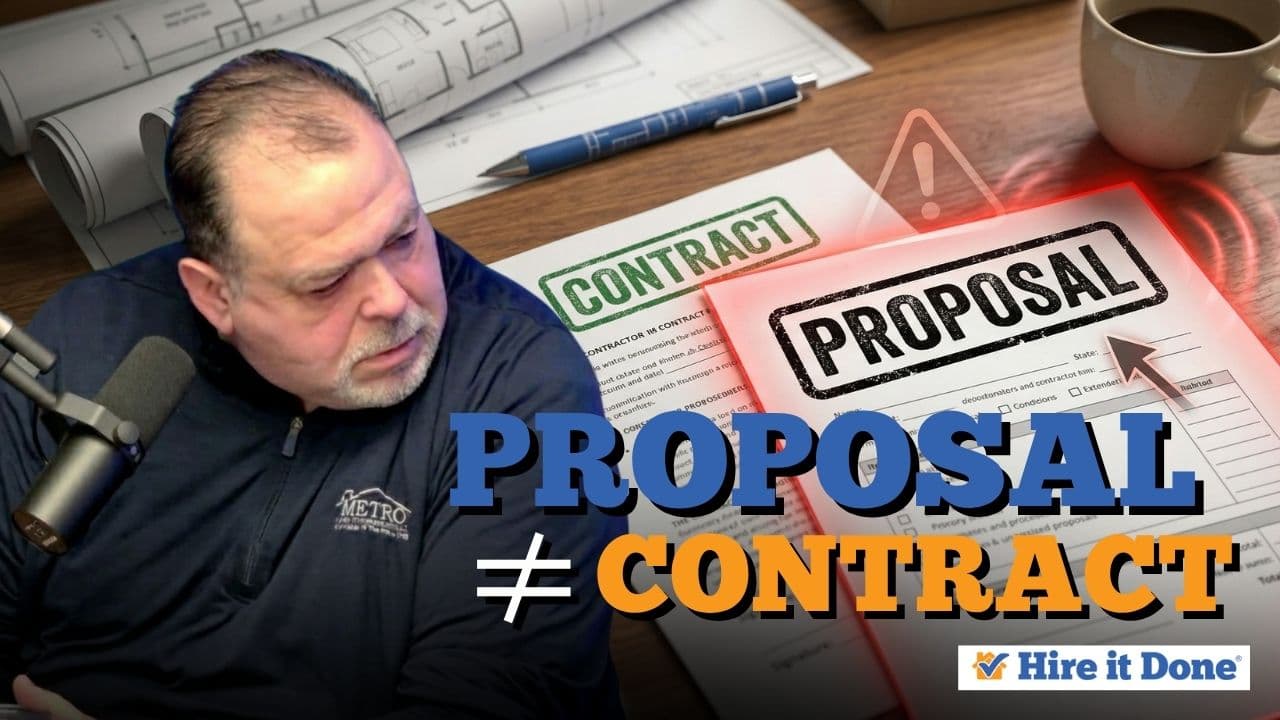

Signing the wrong paperwork is one of the easiest ways to turn a home remodel into an expensive mess.
A lot of homeowners think a proposal and a contract are basically the same thing. They are not. And if you sign a vague document before a major renovation, room addition, or kitchen remodel, you can end up arguing over scope, price, timeline, punch-list items, and who was supposed to do what.
That was one of the most useful parts of a recent Hire It Done episode with Brian Lee of Metro Home Improvements. Brian has decades of experience handling major renovations across Macomb County, Metro Detroit, and surrounding Southeast Michigan communities. In the episode, he and Adam Helfman broke down a mistake that homeowners make all the time: they sign a proposal like it is a finished contract, then act surprised when confusion shows up later.
If you are planning a remodel in SE Michigan, here is what you need to check before you sign anything.
A proposal is not the same as a contract
This is the first thing you need to understand.
Brian said it plainly: “Eight out of 10 contractors don’t write contracts. They write proposals.”
That matters because a proposal is often just a rough outline of what a contractor plans to do. It may include a price, a few line items, and a short description. But that does not mean it gives you the level of protection or clarity you need for a serious home improvement project.
A real contract should go much further. It should clearly explain the scope of work, project sequence, payment structure, responsibilities, exclusions, and what happens if the job changes. It should help both sides understand the job the same way.
If you are hiring for a room addition, basement finish, kitchen expansion, or full remodel in Metro Detroit, do not treat a one-page estimate like it covers everything. It probably does not.
That does not mean every short document is bad. It means you need to know what it is. If it is only a proposal, treat it like a starting point, not the final agreement.
Make the contractor spell out what is not included
Most homeowners focus only on what the contractor says is included. That is only half the job.
Adam gave one of the best homeowner tips in the episode: when the contractor hands you a proposal, review it and hand it back with one clear request. He said you should tell them, “I appreciate this road map, but I need you to write in this proposal what’s not included.”
That one move can save you a lot of money and frustration.
Why? Because disputes usually come from assumptions. You thought painting was included. The contractor thought it was excluded. You assumed cleanup meant full haul-away and final wipe-down. They assumed it meant basic debris removal. You thought permit fees were built in. They thought you knew those were separate.
When exclusions are written down, you force clarity before the work starts.
For a major remodel, ask about exclusions tied to:
- design and blueprint work
- permit fees
- demolition and debris removal
- temporary walls or site protection
- electrical, plumbing, or HVAC upgrades beyond the visible scope
- flooring transitions
- painting and trim touch-ups
- fixture allowances and finish selections
- cleanup and final punch-list items
The more detailed the exclusions, the less room there is for finger-pointing later.
Your contract should read like a story
This was another strong point from the Hire It Done episode. Adam said the proposal should be written “like a story, a beginning, a middle, and an end.” Brian agreed and explained how he structures his own contracts.
That is exactly how a homeowner should think about it.
A strong remodeling contract should show you the flow of the job in plain order. Not random bullets. Not vague phrases. A sequence.
Adam described the beginning as design, permits, planning, and staging. The middle covers rough work, framing, and the heavy construction phase. The end should lead to usable completion.
Brian gave specific examples from his own contracts. He starts with the work to be done at the property address. Then he moves through steps such as drawing blueprints, applying for permits, obtaining permits, starting work after permit approval, digging the foundation, hauling dirt, and building the project all the way through.
That is what you want.
If you are reading a home remodel contract in Southeast Michigan and you cannot follow the order of the job, slow down. Ask the contractor to rewrite it more clearly. A good contractor should be able to explain the project in a way that makes sense to you.
This is especially important for bigger projects where multiple trades, inspections, and city approvals affect the schedule. A room addition in Macomb County or Metro Detroit is not just “build addition.” It is a chain of steps. Your paperwork should reflect that.
 Keep the language simple enough to understand
You should not need a construction background to understand your own contract.
Adam made that point directly when he said homeowners can ask the contractor to “write this contract like you’re in sixth grade.” That is not an insult. That is smart advice.
Simple writing reduces misunderstandings. It keeps the document readable. It makes it easier to catch missing details. It also helps you explain the agreement to your spouse or anyone else involved in the decision.
If the contract is full of vague wording, legal-sounding filler, or unclear descriptions, ask questions until it becomes plain. You are not being difficult. You are protecting yourself.
Before you sign, make sure you can answer these questions in your own words:
What exactly is being built or renovated? What is the contractor responsible for? What items or tasks are excluded? What happens first, next, and last? When are payments due? What triggers a change order? What counts as completion? What happens if materials are delayed or selections change?
If you cannot answer those questions, you are not ready to sign.
Put change orders and delays in writing before they happen
A remodel rarely goes perfectly from start to finish without changes. The question is not whether something shifts. The question is how your contract handles it.
Brian made a good point when Adam asked about penalty clauses for delays. Brian said he would only entertain that if it worked both ways. He gave examples that still matter for homeowners: if you do not let the crew in on time, if you make changes not in the original contract, or if you switch selections late, that affects the schedule too.
That is fair.
Your contract should explain how changes are handled before the job begins. If you change tile, add lighting, move a wall, or upgrade finishes, that should trigger a written change order. That change order should show the added cost, any time extension, and what exactly changed.
This protects both sides.
Without that process, you can end up in the most common remodel fight of all: the homeowner says the contractor is dragging the job out, while the contractor says the homeowner kept changing the job after work started.
For homeowners in Metro Detroit and SE Michigan, this is a big deal because permitting, inspections, weather, and material timing can already add pressure to the schedule. Do not make the paperwork weaker than the project itself.
A lawyer can help, but a better contract helps first
Adam raised a question many homeowners ask after a bad experience: should a lawyer review the contract?
Sometimes, yes. If the job is large, the agreement feels unclear, or you have been burned before, legal review may be worth it. But the episode also made a more practical point. The first line of defense is not panic. It is a stronger contract.
If the scope is specific, exclusions are written down, the payment schedule is clear, and the work sequence makes sense, your risk drops. You may still choose to have a lawyer review the document for a large project, but at least you are giving them something solid to review.
A vague proposal is harder to protect than a detailed contract.
Cheap paperwork usually comes with bigger risk
Brian did not sugarcoat this either: “You spend cheap today, you spend thousands tomorrow.”
That warning was about more than price. It was about the kind of contractor who hands you weak paperwork, takes a deposit, skips permits, and leaves you with a bigger problem than the one you started with.
In the episode, Brian talked about what happens when homeowners choose the wrong person. Crooked additions. No permit. No license. City involvement. Stress. Complaints. Extra cost.
That is why the document and the contractor go together. A weak proposal from an unlicensed or uninsured contractor is not just bad admin. It is a warning sign.
Before you sign anything, verify that the contractor is licensed where required, insured, experienced in your project type, and willing to document the job clearly. If they resist clarity before the project starts, expect more resistance after the deposit clears.
 Final payment should match the real remaining work
A strong contract should also help you avoid the ugly fight that often happens at the end of a project.
Brian described a common scenario: the job is nearly done, but a few punch-list items remain, maybe a cabinet door or a couple of missing knobs. The homeowner wants to hold the full final payment. The contractor pushes back.
His solution was practical. If the final balance is $5,000 and the remaining items clearly do not represent $5,000 worth of work, hold back an amount that fits the unfinished items. In his example, release $4,500, hold back $500, and write a change of contract stating the contractor will return to finish those items and the final amount is due upon completion.
That is the kind of common-sense detail worth addressing early. Your contract should define closeout clearly enough that both sides know how final payment works.
If you are planning a major remodel in Southeast Michigan, do not rush through the paperwork just because you like the design or trust the salesperson. Read the document carefully. Push for specifics. Ask what is excluded. Ask how changes are handled. Ask how the project moves from start to finish. Ask what completion actually means.
That advice comes straight out of a recent Hire It Done episode with Brian Lee of Metro Home Improvements, and it may be the cheapest protection you get on the whole project.
Tags: