



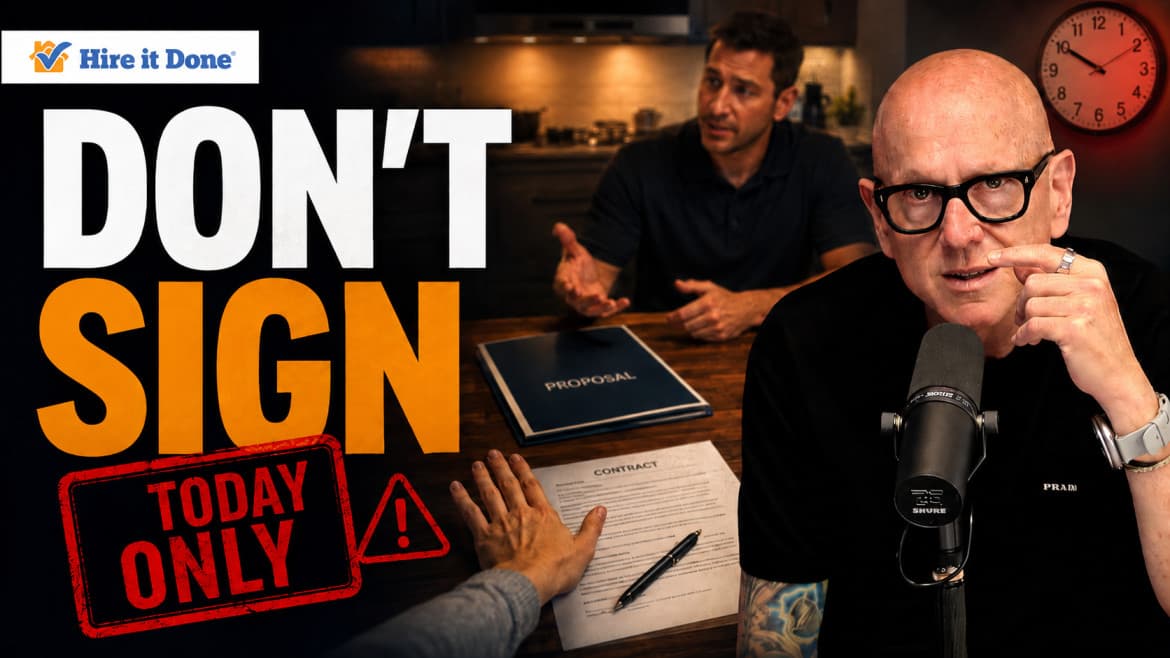

Hiring a contractor should help you feel clearer about your home project. It should not leave you feeling cornered at your own kitchen table.
In a recent Hire It Done episode, home-improvement expert Adam Helfman focused on one of the most uncomfortable parts of buying a roof, windows, a kitchen, a bath, or another major project: the salesperson who will not take no for an answer.
Adam's message to homeowners was simple. A good contractor or salesperson should give you information, answer your questions, and let you make a decision. If someone needs to rush you, scare you, confuse you, or keep you from comparing options, treat that behavior as a warning sign.
Knowing what pressure looks like before an appointment can help you stay in control when the sales conversation starts moving fast.
Know What Professional Selling Looks Like
A salesperson is there to sell. That alone is not a red flag.
A professional salesperson should listen to what you need, inspect the project, explain your options, answer your questions, and provide a clear written proposal. You should come away understanding what work is being recommended and why.
The problem starts when selling turns into pressure.
Adam described common warning signs such as creating fear, manufacturing urgency, using confusing layers of pricing, making you feel guilty, isolating you from other opinions, or making it uncomfortable to say no.
That difference matters. You are not looking for a contractor who refuses to ask for the sale. You are looking for one who can earn the sale without taking away your ability to think.
Set Expectations Before the Appointment
One of the easiest ways to protect yourself is to set the ground rules before the salesperson arrives.
Adam recommends telling the company that you are gathering prices and are not ready to make an immediate decision. You can also explain that you may be getting other quotes and are still deciding when the project will happen.
That is not disrespectful. It is useful information for both sides.
A response such as, “No problem. We'll come out, give you a price, and you can call us when you're ready,” tells you the company understands the purpose of the appointment.
It also gives you something to refer back to later if the conversation suddenly turns into a demand for a same-day signature.
Be Careful With “Today Only” Pricing
Few sales lines create pressure faster than, “This price is only good today.”
The timing is part of what makes it effective. You may already have spent an hour listening to a presentation. You may be tired, distracted, or simply ready for the appointment to end. Suddenly, waiting until tomorrow feels like losing money.
Adam's advice is not to argue about whether the price will really disappear. You can simply say that you are not ready to buy today and that you understand if the offer cannot be extended.
One line from the episode captures the point well: “If the product, the company, and the price are really that good, they should hold up tomorrow morning too.”
The goal is not to prove the salesperson wrong. The goal is to make the decision on your terms.
Understand Why Prices Can Move
A homeowner may also see a price change several times during the same appointment.
Adam explained that salespeople can work under different commission structures and may have room to lower a price. As the selling price changes, the salesperson's compensation may change too.
That does not mean every price adjustment is dishonest. Contractors may have legitimate reasons for changing a proposal.
What matters is whether the company can explain the change clearly and put the final terms in writing.
If the explanation is vague, the discount seems to exist only to force an immediate decision, or the salesperson keeps adding new “special” reasons to sign, slow down.
As Adam put it, “You should not make a five-figure decision because someone has a stopwatch on the kitchen table.”
Watch for the Manager Call
Another familiar sales technique is the call to the manager.
The salesperson may step outside, make a phone call, return with a new number, or put a manager on speakerphone. Sometimes there may be a legitimate approval process behind the call.
The problem is when the conversation becomes another layer of pressure.
You might hear about a sales contest, a bonus, a special exception, or a discount that supposedly exists only if you sign immediately.
Your job is not to figure out whether the phone call is real. Your job is to decide whether the final proposal makes sense for your home.
Ask for the price in writing. Confirm the scope. Review the terms. Then decide based on the work and the company, not on the story around the discount.
Make Fear-Based Claims Prove Themselves
Home problems can be serious. Active leaks, structural concerns, and other conditions may require quick attention.
But urgency should be supported by evidence.
In the episode, Adam recommends asking for photos, measurements, written findings, and, when appropriate, a qualified second opinion.
If a salesperson tells you your roof could collapse, ask a direct question: What is so unsafe about my roof today?
That question changes the conversation. Instead of reacting to fear, you are asking the contractor to explain the condition.
A serious professional should be able to show you what they found and why it matters.

Do Not Let the Appointment Become a Marathon
Long appointments can wear down even a careful homeowner.
Adam described the “marathon appointment,” where the salesperson stays for hours and the homeowner eventually feels like signing may be the easiest way to end the meeting.
You can avoid that by setting a time limit at the beginning.
Tell the contractor how much time you have and ask them to focus on the inspection, your options, and the written proposal.
When the time is up, you are allowed to end the appointment.
A simple closing works: “Thanks for coming. We're done for today. Please leave the information, and we'll contact you.”
You do not owe anyone unlimited access to your time because they came to give you an estimate.
Compare More Than the Price
Pressure is easier to resist when you know what you are actually comparing.
Do not look only at the headline number. Compare the scope of work, installation process, workmanship, documentation, references, and how each company answers your questions.
Adam makes an important point about roofing: two contractors may sell the same product, but the products are not installed by the same people.
That means brand alone cannot tell you which contractor will deliver the better job.
The same principle applies across home improvement. A lower price can become expensive if the scope is incomplete or the workmanship is poor.
Use a Simple Same-Day Decision Script
When a salesperson says you must sign now, you do not need a complicated response.
Adam suggests saying, “I don't make same-day decisions on major home improvements. And if that means it's not the right company for us and we're not a match, I understand.”
That statement does not attack the contractor. It simply defines how you make major decisions.
A good company should expect homeowners to ask questions, check references, compare bids, and take a major purchase seriously.
Make the Decision With a Clear Head
Home improvement is stressful enough without artificial pressure added to the process.
The best way to protect yourself is not to become suspicious of every salesperson. It is to recognize the difference between a professional who is trying to earn your business and a pressure tactic designed to make you act before you are comfortable.
Set expectations early. Ask for the proposal in writing. Make urgent claims come with evidence. Compare the installation and scope, not just the brand or price. And give yourself permission to say no when the process stops feeling professional.
Your contractor should make the project clearer, not make your decision harder.
Tags: