



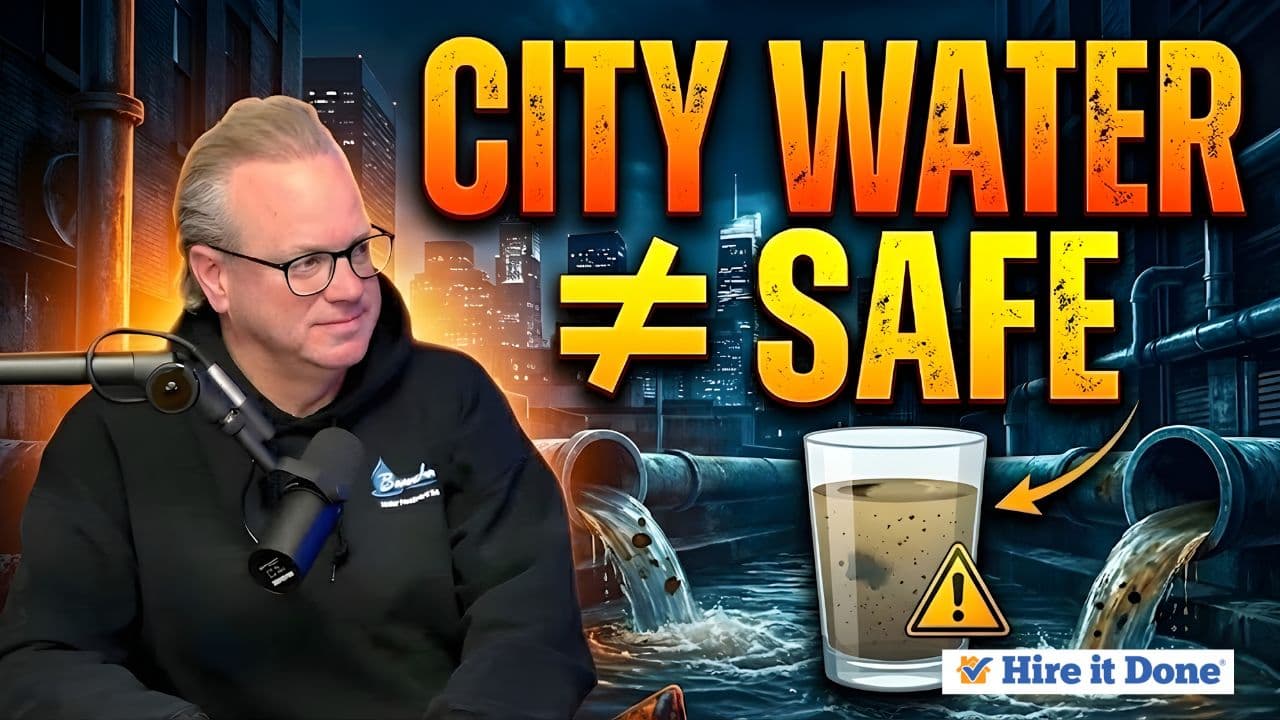

If you assume the water coming from your faucet is already safe, you’re not alone. Most homeowners in Southeast Michigan believe the hard work ends at the municipal plant or the well outside their house.
But that’s not where the real work begins.
This insight comes directly from a recent Hire It Done episode, where Adam Helfman sat down with Jerrad Beauchamp, owner of Beauchamp Water Treatment Solutions, to walk homeowners through what actually happens to water before it reaches your glass.
And more importantly—what you should do about it.
Your Water Changes Before It Reaches You
You can have “clean” water leaving a city system and still end up with contaminants by the time it reaches your kitchen.
Why?
Because water travels through aging infrastructure, underground pipes, private service lines, and plumbing systems that were never designed for modern contaminants. Even well water—pulled straight from the ground—can carry iron, arsenic, bacteria, sulfur odors, and hardness minerals.
That’s why water treatment should never be assumed. It has to be verified.
Water quality problems usually fall into two categories:
- Health-related contaminants (lead, arsenic, bacteria, PFAS)
- Aesthetic problems (taste, odor, stains, scale, dry skin)
You can’t see many of these issues—but they still affect your health, appliances, and daily comfort.
Why Testing Comes Before Equipment
One of the biggest mistakes homeowners make is buying equipment before understanding their water.
Water treatment is not one-size-fits-all.
On the episode, Jerrad explained that proper water treatment is a la carte. Some homeowners only want to eliminate rust. Others want purified drinking water at every tap. The solution depends entirely on what’s in your water.
That’s why professional testing matters.
A proper test identifies:
- Hardness levels
- Iron and mineral content
- Chlorine or chemical presence
- Bacteria risks
- Aesthetic issues affecting taste and smell
Once you know the problem, the solution becomes clear—and cost-effective.

How Whole-Home Filtration Actually Works
Water treatment doesn’t happen at a single device. It’s a system.
During the episode, the full process was broken down step by step:
Pre-Filtration Comes First
This stage removes sediment, rust, chlorine, and high iron levels before water reaches your main system. It protects everything downstream.
Softening Protects Your Home
Water softeners remove hardness minerals like calcium that cause:
- Scale buildup on fixtures
- Cloudy dishes
- Dry skin and hair
- Premature appliance failure
Soft water improves efficiency, comfort, and longevity across your entire home.
Post-Filtration Handles Modern Threats
This is where serious contaminants are addressed:
- Lead
- PFAS
- PFOA
- Industrial byproducts
These filters provide near whole-house purification—especially critical for Southeast Michigan homeowners concerned about aging pipes and environmental exposure.
UV Protection Eliminates Bacteria
Ultraviolet light neutralizes bacteria and pathogens without chemicals. In many states, this is becoming a standard requirement.
Reverse Osmosis for Drinking Water
Reverse osmosis delivers purified water comparable to high-end bottled water—without microplastics, recurring costs, or plastic waste.
As discussed on the show, bottled water often introduces new problems instead of solving old ones.
Why Cheap Systems Can Create New Problems
One of the most eye-opening moments in the episode came when Jerrad explained what happens inside low-cost filtration systems.
Cheap resins and economy filters can break down over time—adding microplastics back into your water.
Testing for microplastics exists, but it’s expensive. That’s why the smarter move is investing in quality equipment upfront instead of testing endlessly after the fact.
In short:
- Cheap systems don’t save money long-term
- Inferior materials introduce new contaminants
- Proper filtration eliminates the problem at the source
What Clean Water Really Costs
Another myth addressed on the show: clean water is expensive.
In reality, most homeowners spend more buying bottled water over time.
Based on the discussion:
- Entry-level softening systems may cost less upfront—but fail early
- Mid-range professional systems deliver the best long-term value
- High-end systems provide purified water throughout the home
Once installed, producing purified water at home costs pennies per gallon.
No weekly purchases. No plastic waste. No guessing.
The Difference a Professional Makes
Water treatment isn’t just about equipment—it’s about who installs it.
Throughout the episode, one theme stayed consistent: education over pressure.
Professional providers:
- Test before recommending
- Explain options clearly
- Price transparently
- Stand behind their work
That approach eliminates anxiety—especially for homeowners who’ve been burned by contractors before.
When something needs adjustment, professionals fix it. No excuses. No surprise charges.
Why This Matters for Southeast Michigan
SE Michigan homeowners face unique challenges:
- Older plumbing infrastructure
- Mixed city and well water systems
- Industrial runoff history
- Seasonal water fluctuations
That makes local expertise critical.
Understanding how water behaves in this region—and how to treat it properly—protects your health, your home, and your investment.

Clean Water Is a Decision, Not a Guess
The takeaway from this Hire It Done episode is simple:
You don’t need fear-based sales. You don’t need complicated jargon. You don’t need endless testing.
You need clarity.
Clean water starts inside your home, with informed decisions and trusted professionals guiding the process.
And once you experience properly treated water, you’ll never look at your faucet the same way again.
Tags: