



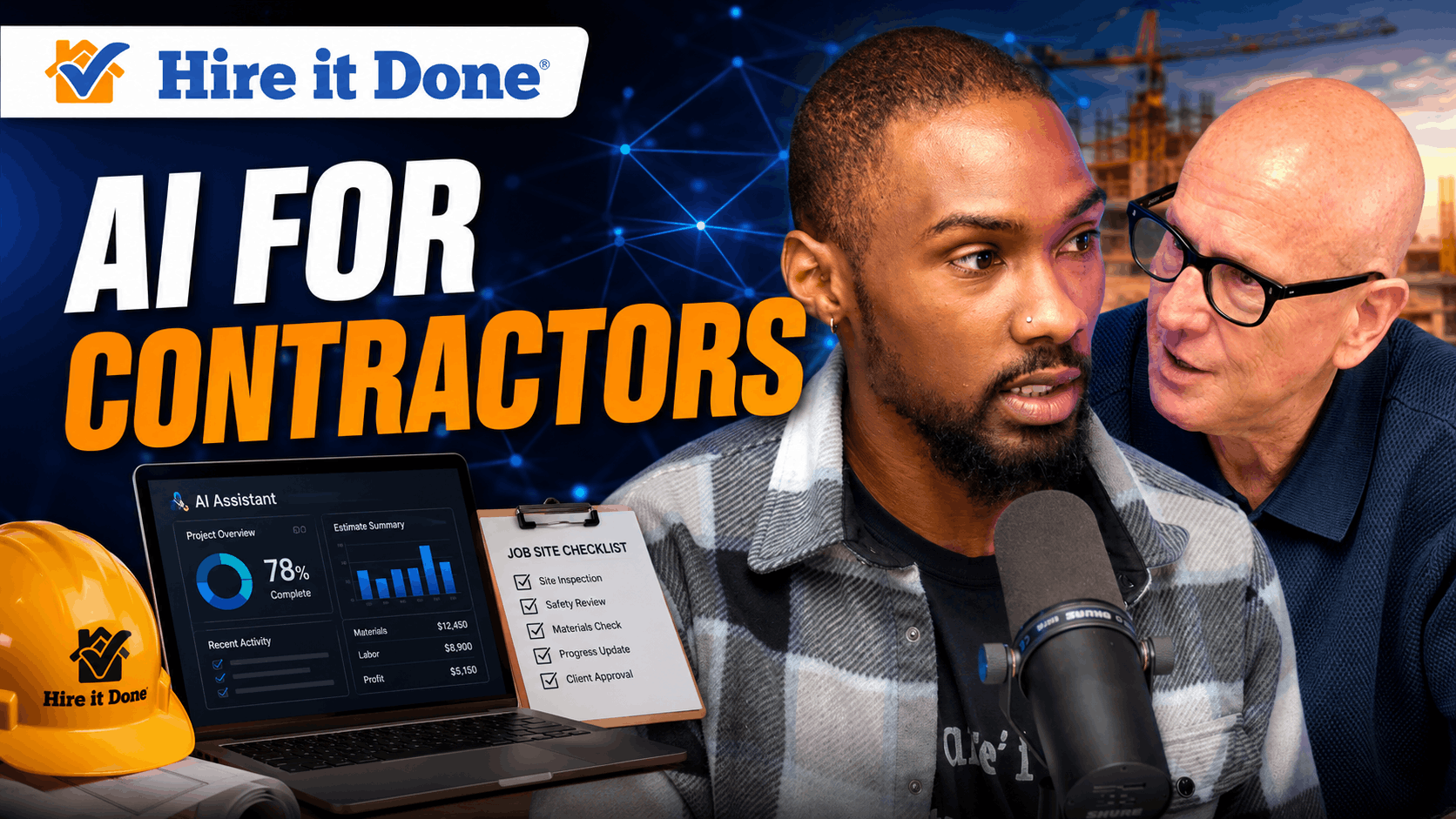

Artificial intelligence is no longer just a tech topic. It is becoming a business topic for contractors, home service companies, remodelers, roofers, dumpster rental businesses, and anyone who depends on being found, trusted, and hired by homeowners.
That was the focus of a Hire It Done podcast conversation with George Byers, founder of CodeHosted.com. George is the developer behind the Hire It Done website and works with technology, AI, websites, SEO, and automation for service-based businesses.
The big takeaway from the conversation was not that contractors need to become software experts. They do not. The takeaway was much more practical: contractors need to understand where technology is already changing customer expectations and business operations.
The companies that adapt will have an advantage. The companies that ignore it may still be good at the work, but they could become harder to find, harder to book, and harder to trust online.
What Does AI Actually Mean for Contractors?
George gave one of the simplest explanations of AI in the episode. He said that, at its core, AI is a guessing machine. It looks at patterns, uses data, and predicts the next likely step.
That explanation matters because it strips away the hype. AI is not magic. It is not a mysterious robot taking over the jobsite. In practical business terms, AI can help organize information, generate content, summarize data, improve search, power chat tools, automate repeated tasks, and help customers move faster through a decision.
For contractors, that could mean better website content, faster customer response, cleaner internal systems, smarter marketing, more efficient scheduling, easier ordering, or better follow-up.
The key is not to ask, “How do I use AI?” in a vague way. The better question is, “Where is my business wasting time or losing opportunities?”
Why Old-School Contractors Need to Pay Attention
Many contractors are excellent at the work but behind on the business systems around the work. They may still rely on outdated websites, weak online visibility, slow response times, paper notes, scattered texts, or manual follow-up.
That might have worked years ago. It is becoming harder now.
Homeowners expect speed. They expect clarity. They expect to find answers online before they ever call. If a business looks outdated, confusing, or hard to work with online, some homeowners will move on to the next option before that contractor ever gets a chance to prove the quality of the work.
That is why websites, SEO, online forms, booking tools, and automation are not just “tech stuff.” They are part of the customer experience.
A contractor does not need to chase every new platform. But ignoring the digital side of the business can quietly cost leads, trust, and momentum.
What Trashed.app Shows About Practical AI
One of the clearest examples from the episode was Trashed.app, a platform George built for dumpster rental and junk removal.
Dumpster rental is a practical, old-school, jobsite-driven industry. Contractors need dumpsters. Homeowners need dumpsters. Companies have inventory, pricing, service areas, and availability. The problem is that the process can still involve calling around, waiting, checking availability, and trying to coordinate around a busy project.
George explained how Trashed uses data and AI to make that process easier. A customer can enter an address, choose a dumpster size, and the platform can work in the background to match the order with a provider based on things like inventory, pricing, location, and distance.
For dumpster rental companies, one of the strongest points is that Trashed can provide an instant storefront. That means a company may be able to start accepting online orders without first building a full website from scratch.
That is the kind of AI and automation contractors should be paying attention to. It is not abstract. It solves a real operational problem.
Start Where Your Data Already Lives
One of George’s most practical recommendations was to go where the data is.
In other words, do not start by chasing every AI tool you see online. Start with the tools that already connect to where your business information lives.
If your business runs on Google Workspace, look at Gemini. If your company is built around Microsoft, look at Copilot. If you are using certain platforms every day, it often makes sense to explore the AI tools already built around that environment.
Why? Because AI is more useful when it has access to relevant information. The less copying, pasting, exporting, and reconnecting you have to do, the more useful the tool becomes.
For a contractor, that could mean using AI to help summarize customer notes, draft email replies, organize documents, update content, or support marketing tasks based on the information already in the business
What Are AI Agents and Why Do They Matter?
Another major topic in the episode was AI agents. The term can sound complicated, but George explained it simply. An AI agent is basically a large language model equipped with tools.
That means it is not just answering a question. It can be designed to do something.
For example, an agent might send an email, send a text, scan the web at a certain time, collect data, move information into a system, or trigger a workflow. That is where AI starts moving from a chat box into business automation.
For contractors, this could eventually mean automated follow-ups, smarter lead intake, jobsite update summaries, review requests, content generation, scheduling support, or market research that runs without someone manually doing every step.
The important thing is to approach this carefully. Automation should support the business, not create more chaos. The best systems are the ones that make the work clearer, faster, and easier for both the contractor and the customer.
Good Technology Should Make the Business Easier
A theme throughout the conversation was simplicity. George talked about building tools that are modern, productive, easy, and affordable.
That matters because many contractors do not have time to learn complicated software. They are running jobs, managing crews, talking to customers, pricing work, solving problems, and keeping projects moving.
If a technology tool makes the business harder, it will not last.
The best tools reduce friction. They make it easier for homeowners to take action. They make it easier for the contractor to respond. They help the business look professional, stay organized, and move faster.
That is where AI can become useful for home service companies. Not as a gimmick, but as a practical layer inside the business.
The Real Risk Is Waiting Too Long
Contractors do not need to overhaul everything overnight. But they should not ignore the shift either.
AI, websites, search, online storefronts, and automation are all changing how customers interact with service businesses. The contractor who waits too long may still be great at the craft, but they may become harder to find and harder to hire.
The smart move is to start small. Review your website. Look at your online presence. Ask where customers are getting stuck. Think about which repeated tasks are eating time. Then look for technology that solves those specific problems.
That is the practical way forward. Not hype. Not fear. Just better systems for better businesses.
For contractors and home service companies, AI is not about replacing the work. It is about improving everything around the work so the business can serve customers better and operate with less friction.
Tags: